Painting as a threshold space between inner and outer
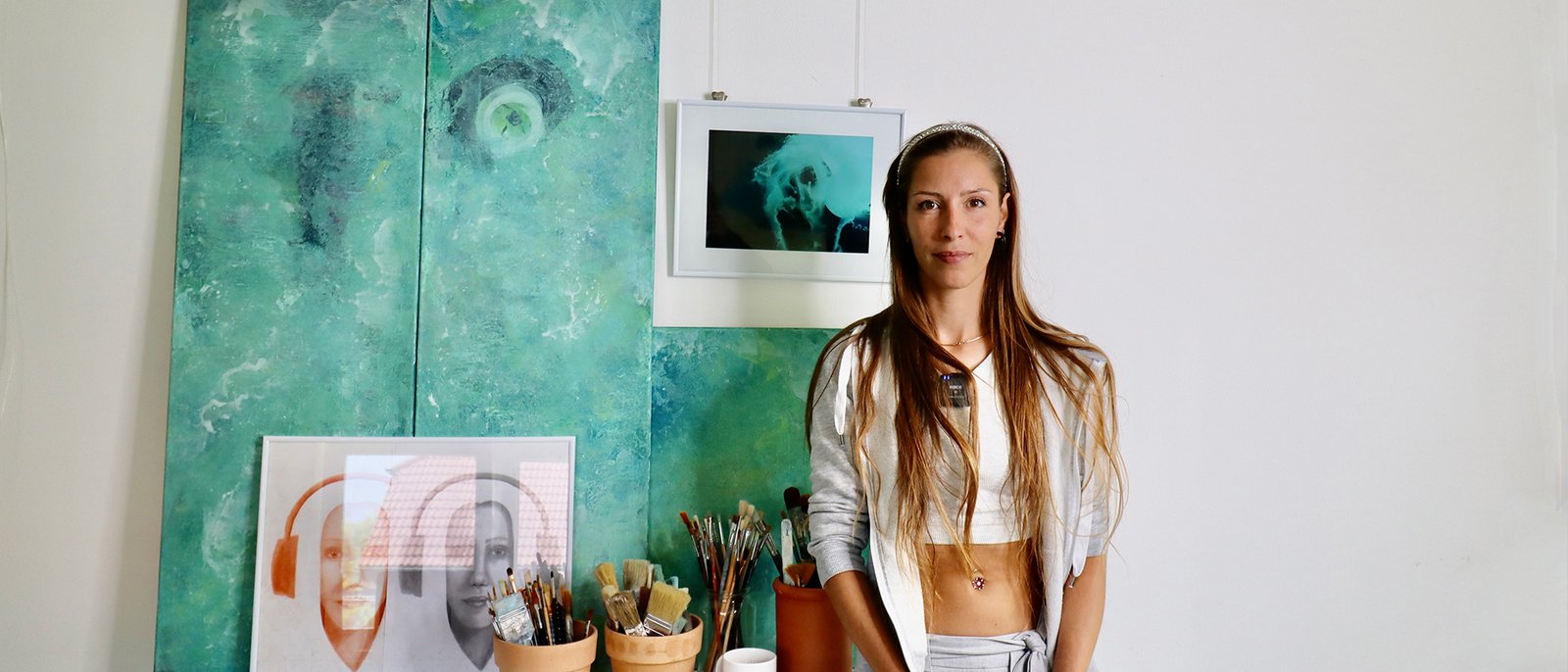
In the summer of 2025, the Berolina Galerie in the Berlin City Hall Mitte will open its doors to an artist whose work re-explores the intersection between sensation and expression. The exhibition “Between Dream and Reality” by Abby McRey, curated by Diana Achtzig, is not only seen as the culmination of an artistic education at the Achtzig Kunstakademie Berlin for Fine Art and Painting, but as a visible crystallization point of a pictorial self-conception developed over years.
The works on display not only address formal questions of figuration and abstraction, but create a field of tension in which memory, identity, and introspection become visible in dialogical intertwining with social reality. The present art historical contribution examines McRey's work in the context of contemporary image theory, painting practice, and aesthetic perception.
My paintings arise from states – not from concepts. I paint what I remember, not what I can explain.
1. Image discovery as a poetic process of remembrance
At the center of McRey's work is an artistic process that is less analytical and more intuitive. Her painting does not follow the logic of representational depiction but is based on a memory-driven approach to visual worlds that often present themselves fragmentarily, in layers, and suggestively.
Particularly in the works of the Berolina exhibition, it becomes apparent that McRey understands the painting surface as a palimpsest-like structure: Each layer remains translucent, visible in the overlap, deliberately playing with omissions. Her pictorial spaces appear like mental maps of an inner realm of sensation.
The artist employs a “visual semantics of the approximate”: The colors fluctuate between pastel delicacy and melancholic earth tones. Bodies and contours emerge only to disappear again. The figuration remains latent – an echo, not a statement. This oscillating moment gives McRey's work that in-between character that consciously eludes the binary thinking of dream or reality.
2. Aesthetic Topography: Three Stations of an Image Cosmos
The retrospective consideration of McRey's previous exhibitions shows that her art practice is not to be understood as a finished product, but as a processual preservation of individual and collective experience.
2.1. Berolina Galerie – Art as Memory Layering
The exhibition “Between Dream and Reality” at the Berolina Galerie functions as both a culmination and a new beginning. Here, the individual inner world—particularly biographical-psychological states—is transferred into a public resonance space. The watercolors and acrylic paintings of this show make a quiet, almost meditative quality tangible.
The special aspect does not lie in the subject matter, but in the timbre of seeing: The gaze is not directed but invited. The images do not provide information; they demand an attitude. Through this openness, image spaces emerge that unfold an emotional impact through their quiet pathos—without explaining.
2.2. Galerie M – Cityscape as an Emotional Sediment Surface
In the project space Galerie M, McRey enters a different form of dialogue with the environment: Here, the urban structure itself is part of the image discourse. In the series “Asphaltträume”, she uses geometric form fragments, blurred typography, and subtle color contrasts to analyze the social space of the metropolis as an affective echo.
These works clearly show the attempt not to illustrate the city, but to feel it – as a place of friction, as a surface for the invisible. This becomes particularly evident in the handling of material: The glazing layers of paint are reminiscent of peeling facades, painted-over graffiti, weathered posters. It is an art of signs, not of images.
2.3. House Compass – Relationship as Image Impulse
In the exhibition “Near and Far” at Haus Kompass, McRey goes beyond the question of personal memory and turns to the Other: The human appears as a trace, as a gaze, as a gesture. The theme of closeness – both in interpersonal and material terms – dominates the delicate works executed on paper.
Here, a form of intimate figuration develops, which eludes any narration. The images appear like diary pages – not readable in the classical sense, but perceptible in the atmospheric interplay of line and surface. In this series, McRey succeeds in establishing a unique visual language for relationship, vulnerability, and tenderness.
3. Media Hybridity: Painting, Photography, Illustration
Abby McRey's work is characterized by a cross-media openness. Her artistic signature is not bound to a format – rather, she understands painting, illustration, and photography as communicative modes of an aesthetic practice that always perceives humans as resonant bodies.
In her photographic work, for instance, it is about the fleeting – shadows, light, materiality. The camera does not function as a technical means of depiction, but as a sensual instrument of lingering. Her children's book characters like Lumi or Luna arise from the same spirit: here too, it is not about storytelling, but about emotionally coded world access.
Art Business: How do I become a professional artist?
This question occupies many creative people who want to turn their passion into a profession. In Achtzig Podcast 195, there is a discussion about what it means to be an artist.
Art Selling Achtzig Podcast #195
4. Contextualization: Between Lyrical Abstraction and New Subjectivity
Art historically, McRey's work can be located between two poles: On one side is Lyrical Abstraction with its affective color poetics; on the other, the New Subjectivity, which in the 1980s rediscovered the inner world as an artistic theme.
McRey's works incorporate elements of both movements – not as a style quotation, but as a continuation. Her art is not retrospective, but relational: It refers to the present experience, to corporeality in the digital age, to fragility in the political space.
The question "What does it mean to feel today?" is not answered in McRey's work – but consistently posed.
5. Reception and Significance: The Artist as the Voice of a Silent Generation
In a time of visual overproduction, Abby McRey sets a counterpoint: Her works are not statements, but spaces of resonance. She eschews irony, spectacle, and quick readability. Instead, she creates – in the spirit of slow aesthetics – an art form of lingering.
The quiet images, the delicate lines, the suggestive color spaces are expressions of an artistic attitude that does not submit to the market, but to truthfulness. It is an attitude that understands vulnerability as strength and thus gives a voice to a young generation of artists who articulate themselves not through loudness, but through depth.
6. Artist Statement – Abby McRey
Artistic work is a constant process of movement. Not in terms of physical relocation, but as inner dynamics, as a circling around form, sensation, and perception. Movement permeates both the creative process and the experience of the finished work – whether in abstract painting or photographic work. In the media, it is not about depiction, but about resonance. Not about the visible alone, but about what it can evoke internally.
In abstract painting, movement is the actual foundation. It begins with the gesture – spontaneous, intuitive, impulsive. Lines, surfaces, color spaces emerge from a physical rhythm, a meeting of impulse and reaction. Color is not "applied," but guided, dammed, discarded, and revived anew. Layers overlap, are broken through, dissolve. The working process is open, dialogic, often contradictory – a constant weighing between letting go and structure, between chaos and composition.
Color plays a central role – not as a decorative element, but as an emotional carrier. It never stands alone, but always exists in relation: to the white of the painting ground, to neighboring tones, to the movement of the brushstroke. Some colors attack, others retreat; some connect, others disrupt. This balancing act between tension and harmony forms the actual framework of the composition.
Abstraction allows one to go beyond objectivity and open spaces that are neither location-bound nor temporally fixed. The viewer is not meant to be "shown" something explicit. Instead, a field of tension arises from traces, rhythms, condensations – something that is neither named nor completed, but continues in the viewer's gaze. It is an invitation to read into the surface – like a
poem without words.
The work thus becomes a projection surface for one's own perceptions, memories, perhaps also for things that cannot be named but are felt. In a world increasingly oriented towards clarity and efficiency, the abstract offers a subtle counter-proposal: the possibility to lose oneself – and perhaps also to find a piece.
The photographic work moves at the boundary between the visible and the invisible. It does not begin with the motif, but with attention: a state of alert seeing, sensing, lingering. Photography means: lingering, waiting, listening with the eyes. It is not about capturing the visible, but about capturing the traces of the fleeting – that which otherwise passes unnoticed. The camera does not function as a technical device, but as an extension of sensitive perception.
It is less the big themes or spectacular scenes that are of interest, but the quiet, the overlooked, that which eludes the quick glance. Photography is not understood here as a means of documentation, but as a tool for deceleration – as a kind of visual pause.
Motifs do not arise from the will to stage, but from the process of looking: a detail, a fall of light, a shadow, a quiet transition. Often it is precisely those unspectacular moments that set something in motion – not outwardly, but inwardly. A fragment that reminds. Color and structure that evoke a feeling.
In a time when images are produced and consumed in infinite quantities, this photographic practice attempts to restore the image's value – as a singular object, as a quiet resistance against visual overstimulation. The images do not want to explain or entertain. They invite you to look, to become still, to remember, perhaps also to marvel.
In both forms – painting and photography – the human as the viewer is not opposite, but in the midst. It is not about the depiction, but about the experience. The works do not demand interpretation, but offer a surface on which one's own movements can unfold: memories, sensations, perhaps also uncertainties. In a world of constant acceleration and explainability, these works understand themselves as a counter-design – as quiet offers to linger, to revisit, to continue inwardly.
For what was in motion in creation does not remain still in the viewer. The surface breathes, the light flows, the gaze wanders. And sometimes it happens very quietly – that something moves. Not on the canvas or in the motif. But where images continue to work: in the head, in the heart, in the not yet nameable – where words end and meaning begins.
Not loud, not tangible – but perceptible. And perhaps precisely because of this: lasting. Just as lasting as knowledge passed on in a playful form. Stories for children arise where fantasy and reality touch each other. They may be playful, colorful, and wondrous – and at the same time full of meaning. The characters Lumi and Luna were created from exactly this spirit: from the desire to lovingly accompany children, to encourage them, and to open the world to them playfully.
"Lumi – the little monster from the TV tower" is the beginning of a journey. Lumi takes children by the hand and explores the city of Berlin with them – curious, open, and with an eye for the special in the everyday. On his paths, Lumi meets other cuddly monsters, discovers friendly corners, bold ideas, and learns not only about places but also how beautiful diversity can be. What begins with Berlin will expand: first to Brandenburg, later perhaps beyond national borders – to where other children live, other languages are spoken, but the same curiosity and joy in stories live.
In another world lives "Luna – the little sleep magic glitter elf." Originally written for a single child who did not like to sleep in their own bed, Luna has developed into a faithful companion through many everyday situations. Whether as a sleep aid, bath story, or support in emotional challenges: Luna tells in calm, short episodes how to become braver, more understanding, more independent – without pressure, but with warmth, magic glitter, and a lot of magic.
Whether monster or elf – at the center of these stories is always the child. The texts do not want to teach, but to touch. They do not want to prescribe, but to encourage. They offer opportunities to empathize, think further, dream. In doing so, they reflect many of the values that are important to parents: self-confidence, empathy, mindfulness, responsibility – all packaged in stories that meet children where they are.
For those who learn early to find themselves in stories also learn to orient themselves in the world – with open eyes, an open heart, and the willingness to take new paths. Whether in color, light, or language – all these works arise from the same source: the desire to set something in motion. In the image. In thinking. And sometimes – very quietly – in the heart.
7. Exhibition Directory and Vita
2021 – 2025 Art studies "Painting" at the "Achtzig Kunstakademie Berlin"
Solo exhibition:
27/06/25 – 16/09/25 Diploma exhibition "Between Dream and Reality" at the Berolina Galerie in Rathaus Mitte
Group exhibitions:
25/08/25 – 23/09/25 "Abundance ... captured in image", Galerie im Kompass Stadtteilzentrum
05/07/25 – 30/08/25 "Water Festival", Projektraum Galerie M
19/05/25 – 02/07/25 "Movement ... captured in image", Galerie im Kompass Stadtteilzentrum
13/01/25 – 10/03/25 "Weather, Clouds, Waves ... captured in image", Galerie im Kompass Stz
01/01/25 – open "Favorite Record"
09/09/24 – 14/10/24 "Hope ... captured in image", Galerie im Kompass Stadtteilzentrum
24/05/24 – 01/07/24 "Flora & Fauna ... captured in image", Galerie im Kompass Stadtteilzentrum
15/03/24 – 20/05/24 "Women's View on Women", Galerie im Kompass Stadtteilzentrum
19/02/24 – 13/04/24 "Obsolete", Projektraum Galerie M
28/11/23 – 15/12/23 "Concrete Fox 2023", Projektraum Galerie M
To the official press release and further information
Press info and further details about the exhibition:
https://www.art-amour.de/?page_id=2204
Artist's website:
https://abby-mcrey.webnode.page
Website of Achtzig Kunstakademie Berlin for Free Art and Painting:
https://www.akademie-der-kunst.de/de/studiengang/freie-kunst-und-malerei