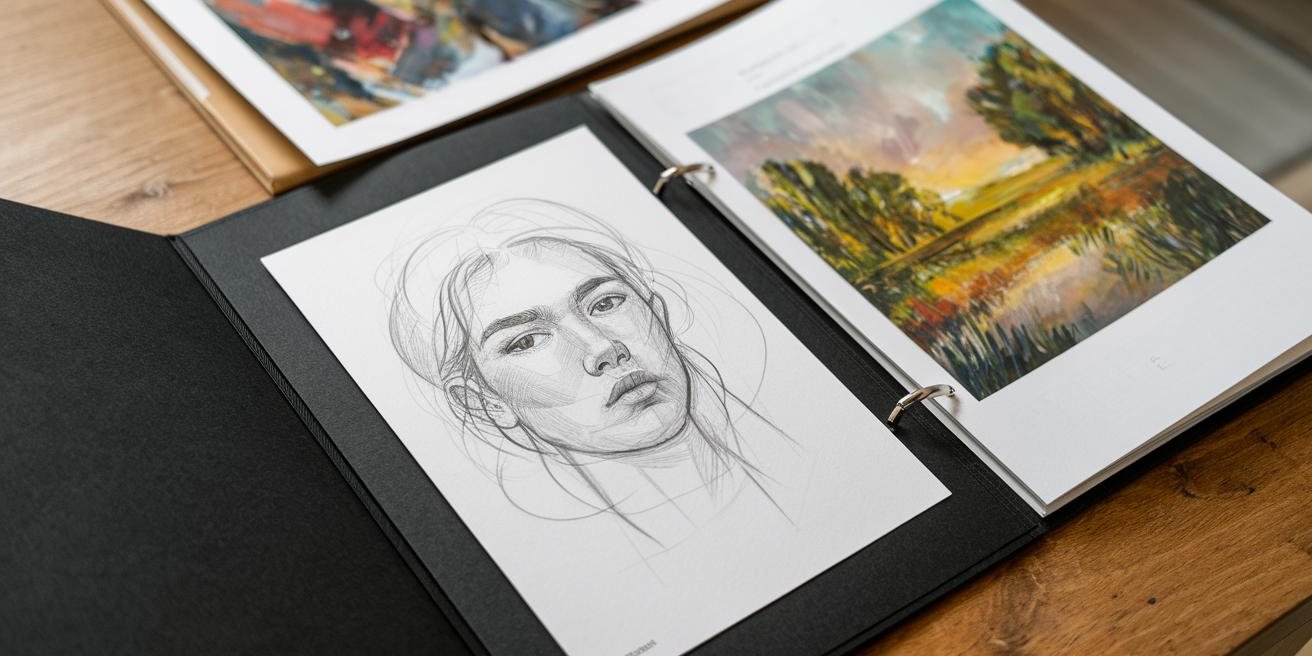
Why the application portfolio decides on your admission
If you want to study Fine Arts, Illustration, Fashion Design, or Communication Design, you almost always have to submit an artistic portfolio. It is the ticket to art studies: based on the portfolio, art schools decide who will be invited to the entrance exam or directly receive a study place. Good grades or a well-crafted cover letter do not replace it.
Many applicants do not fail due to a lack of talent but due to avoidable mistakes. This article shows which study programs require a portfolio, what universities look for, and which ten mistakes you should avoid.
The Essentials in Brief
- A portfolio shows how you think and work – not just how well you can draw.
- Universities look for independent ideas, a personal style, and a willingness to experiment.
- Sketches and work processes are often just as important as finished works.
- Each university specifies the number, format, and deadlines – read the application requirements carefully.
- A rejection is not an endpoint: many are accepted only on the second or third attempt.
10 mistakes in the application portfolio
In the video, the lecturer Diana Achtzig from the Achtzig Kunstakademie Berlin explains which mistakes frequently occur in application portfolios and how you can avoid them.
For which degree programs you need a portfolio
An artistic application portfolio is primarily required for degree programs where creative talent and personal ideas are central:
- Fine Art and Painting – at art academies and art colleges
- Sculpture – often with photos or originals of spatial works
- Illustration – with picture stories, characters, and sketchbooks
- Communication Design and Visual Communication – graphics, typography, media, and advertising
- Fashion Design – with designs, collection ideas, and textile experiments
- Stage and Costume Design – scenographic and textile design for theater and film
- Art Education – at many universities with a portfolio and aptitude test
Subjects such as Photography, Animation, Product Design, or Architecture may also require a portfolio depending on the university. The specific requirements are outlined in the application conditions of the respective degree program.
What art schools want to see in your portfolio
Each university sets its own priorities. However, some criteria appear at almost all art schools, from UdK Berlin to HGB Leipzig to Kunstakademie Düsseldorf:
- Independent ideas: The committee wants to see what interests you and how you approach a topic.
- Personal signature: No copies and no imitations of well-known styles, but your own visual language.
- Experiments with material and technique: Show that you try new things – including unusual materials and large formats.
- Development and process: Sketchbooks, studies, and series show how your ideas arise and develop further.
- Artistic attitude: Your works should clearly have a substantive reference and not just be technically successful.
Many universities offer portfolio consultations or information days. There you can show your work before applying and get an honest assessment – one of the best ways to improve your own portfolio.
The 10 most common mistakes in the application portfolio
These ten mistakes keep appearing in application portfolios – and can be avoided with some planning.
-
Clean, pleasing images without their own idea rarely convince. The commission seeks personality and courage, not flawless schoolwork.
-
A portfolio is not proof of craftsmanship. Good drawing alone is not enough – it should be recognizable what you want to convey with your works.
-
Fruit bowls, sunsets, rainbows, fantasy and manga characters are seen by the commission in every application round. Look for themes that have to do with you and your perspective on the world.
-
Anyone who shows only one technique or medium misses opportunities. Combine, for example, drawing, painting, photography, collage, or spatial works – suitable for your course of study.
-
Working from photo references or from works by other artists shows diligence, but no original image creation. It's better to draw from nature, from a model, or from imagination.
-
Showing only finished works is a common mistake. Sketchbooks, idea pages, and preliminary studies reveal how you think – and are particularly insightful for many commissions.
-
Weak works bring down the overall impression. Only include what truly represents you, and let others help you with the selection.
-
Number of works, formats, assignments or topics, digital or analog submission, deadlines: Those who ignore the application conditions often fail even before the actual review.
-
Creased pages, missing labels, or blurry photos in digital portfolios appear unprofessional. Label each work with title, year, technique, and format, and present them calmly and clearly.
-
A good portfolio is not created in a few weeks. Plan for several months so that you can experiment, discard, and make a coherent selection.
Rejected – and now?
A rejection is disappointing, but not a judgment on your talent. At many art schools, there are numerous applications for a single study place, and many successful artists today were only accepted on their second or third attempt. These steps will help you move forward:
- Seek feedback: Ask for a portfolio review to find out what the issue was.
- Keep working: Use the time until the next application to develop new works and refine your style.
- Apply broadly: Apply to several schools simultaneously and consider related programs.
- Take a portfolio course: Courses at art schools and academies help you work specifically on your portfolio.
- Consider alternatives: Private art academies and part-time programs also offer artistic training, often without a traditional entrance exam.
Conclusion: Attitude counts more than perfection
The application portfolio is the first step into art studies – and a chance to show who you are as an artist. Those who start early, take the university's requirements seriously, pursue their own ideas, and also show the work process have good prospects. Perfection is less important than attitude, curiosity, and a recognizable personal style.
Note: Portfolio courses and distance learning
The Achtzig Kunstakademie Berlin offers digital and analog portfolio courses, including for Fine Arts and Painting, Illustration, Visual Communication, Fashion Design, Stage and Costume Design, as well as Art Education.
Additionally, the academy offers a part-time distance learning program in Fine Arts – for example, for those who wish to continue working artistically after being rejected by a state university.