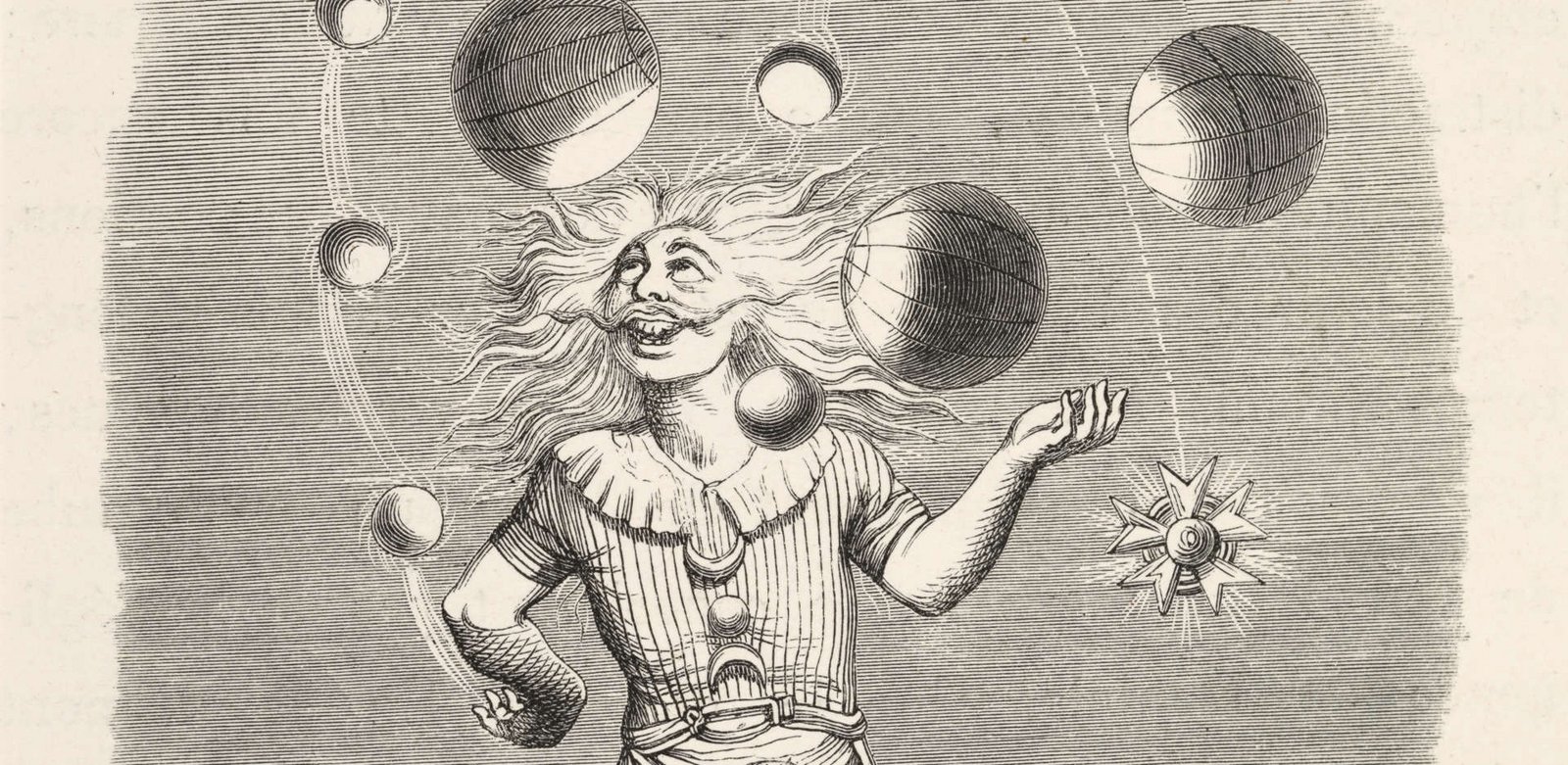
A term on a journey: from tantrum to aesthetic catalyst
“BIZARR” – The Story of the Craziest Word in the World is a special exhibition by the Kunstbibliothek Berlin, on display from November 27, 2026, to March 29, 2027, at the Kulturforum Berlin. The official opening took place on the evening of November 26, 2026.
The exhibition traces the seven-hundred-year career of the word “bizarr”: from its first appearance with Dante in the “Inferno” scene, where a Florentine nobleman tears himself apart in angry fury (“El fiorentino spirito bizarro”), through the Renaissance, Grotesque, and Dream to the present with pop culture references like Frank Zappa’s label and Superman’s counterpart “Bizarro.”
Eight Chapters of an Unusual Story
-
In Dante's Inferno, the word first appears in literature as an expression of extreme anger – the background is probably the Italian "bizza," an onomatopoeic term for an outburst of rage.
-
In the 16th century, "bizarre" was transferred to dream and delusion images – particularly works by Hieronymus Bosch were considered expressions of bizarre fantasy.
-
The unpredictability of the mind was celebrated as an artistic principle: Giovanni Battista Bracelli's capriccio series "Bizzarie di varie figure" (1624) is an early example of how "bizarre" became an artistic quality.
-
Grotesque ornaments, inspired by ancient "grotto" decorations, were celebrated as "dreams of painting" – and appear in the context of the bizarre as visual alienation.
-
In the Baroque period, the bizarre was staged as a provocation to attract attention. Frank Zappa's label "Bizarre" is an example of the late popularization of this effect.
-
Bizarre is also considered for hybrid creatures that defy categories. In the 20th century, they became symbols of individual freedom and identity transformation.
-
The comic can be bizarre: Caricatures were celebrated as "invenzione bizzarissima," comedies as "bizarria da ridere" - laughter became part of the alienation with effect.
-
In the 21st century, the bizarre becomes omnipresent – with Eric Schwitzgebel's theory of "Universal Bizarreness," the relationship is reversed: Normal appears bizarre – a world in inversion. Bosch's double-sided work symbolizes this cosmic escalation.
Exhibition format: More than just pictures
- The show brings together rarely shown drawings, prints, books, and masterpieces from the collections of the Art Library, the Gemäldegalerie, the Alte Nationalgalerie, and the Kupferstichkabinett.
- A comprehensive catalog, edited by Moritz Wullen, comprises about 256 pages with around 160 color and B/W illustrations, is bilingual (German/English), and published by E. A. Seemann Verlag Leipzig; price approximately 49 Euro.
- An audio guide and a podcast, in which Mark Benecke and curator Moritz Wullen discuss the journey from the inferno to the cosmic bizarre, accompany the exhibition.
Practical information for visitors
The exhibition runs from November 27, 2026, to March 29, 2027, in the special exhibition halls of the Kulturforum Berlin (Johanna-und-Eduard-Arnhold-Platz / Matthäikirchplatz, 10785 Berlin).
Open Tuesday to Sunday from 10 AM to 6 PM, closed on Mondays; barrier-free access is guaranteed.
Admission: Kulturforum ticket €22, reduced €11; annual pass €12, reduced €6.
- Official opening event: November 26, 2026, 7 PM.
- Accompanying programs for children, families, teenagers, and teachers: Workshops, tours, and discussion formats on topics such as "Crazy Creatures," "Monster Workshop," or "The Bizarre as a Historical Category."
Curator's voice and cultural context
According to rbbKultur, it was Moritz Wullen, director of the Kunstbibliothek, who, after years of research, realized the first comprehensive exhibition on the word "bizarre." For him, it stands as a contrast to the normal, a crack in the familiar – but also as an expression of alternative freedom and identity.
He points to quirky historical examples such as a hare almost sniffing the step of Venus, and stage costumes half tree, half snail, which were described as bizarre.
Why this exhibition matters
"BIZARR" is the first exhibition that gives such weight to the history of a concept – as a cultural, visual, and philosophical exploration across epochs and disciplines.
It combines art history, philosophy, psychology, and pop culture, invites wonder, and poses the fundamental question: What is actually normal?