Introduction to a Multisensory Sea
Helsinki-based artist Tuomas A. Laitinen presents "Siphon" at New York's Pioneer Works, an installation based on over a decade of research into copper secrets and octopus biology. Here, the copper-containing blood fluid of octopuses becomes a symbol of profound ecological interconnections.
Visual Intensity: Copper Dreams and Skin Landscapes
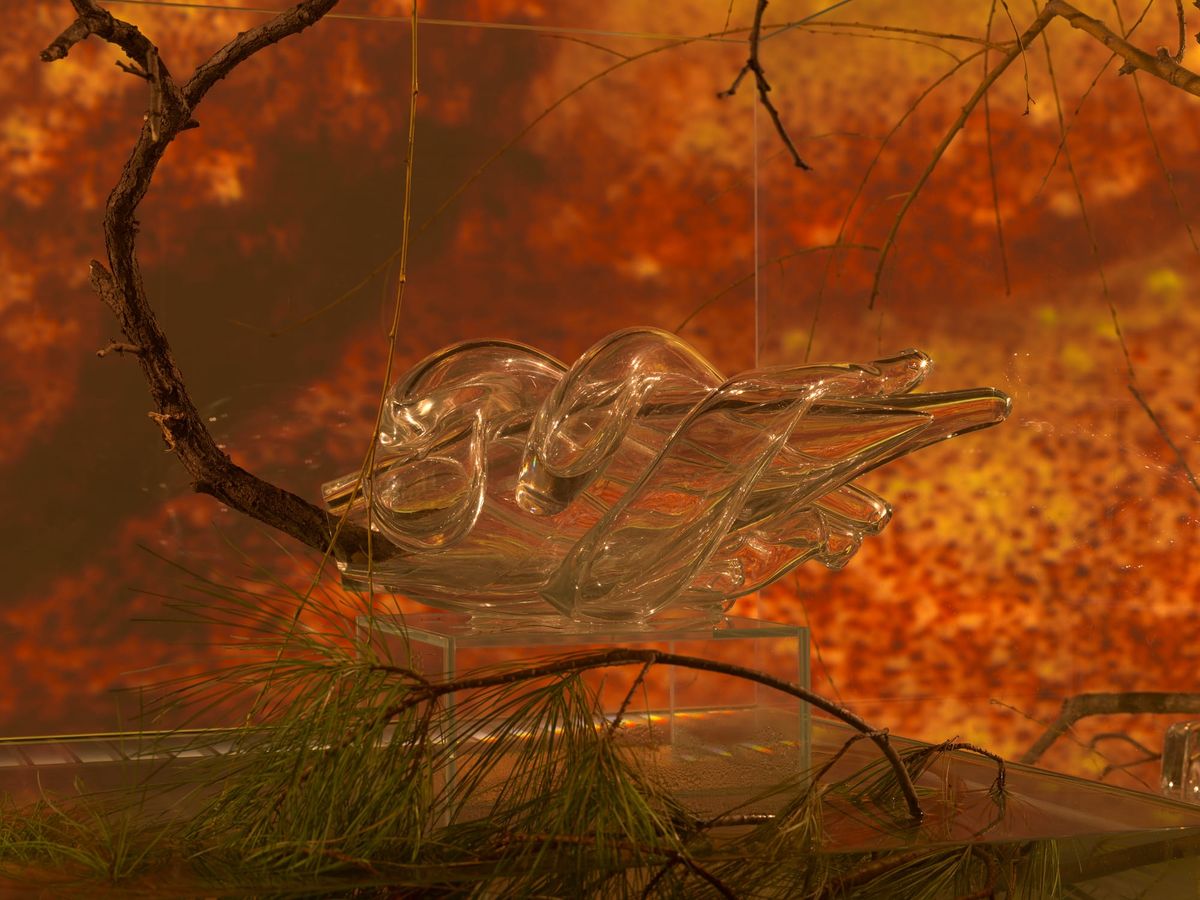
The main hall of the Pioneer Works is filled with wall-filling projections in bright "thermal magentas" and "molten ambers," combining Laitinen's own recordings with sleep sequences of sleeping octopuses from Okinawa. The skin of these animals forms a pulsating, "churning terrain," at the center of which a huge pupil eye looks at the viewer.
Glass art as a possible living space
On a tiered pedestal stand water-filled containers with hand-blown glass bodies – tubular and intertwined – as potential shelters for octopuses. The water structure and the organic forms refer to the fragile connection between life, material, and sculpture.
Ikebana meets Iconography: Ohtsubo's Floral Resonance
The 86-year-old Ikebana master Kosen Ohtsubo complements the installation with traditional floral art: branches, pine needles, yard-long beans, and peanuts on wire create a subtle counterbalance to the dominant projections.
Sound and Body: "8Eternal" as Vibrant Presence
Above the scene hovers "8Eternal" (2026), the voice of Kenyan composer Nyokabi Kariuki, established as narrow sound beams through eight ultrasonic speakers – sound that moves, appears, and disappears, depending on the visitor's position.
"Siphon" in context: Ecology, Materiality, Connection
"Siphon" was created in collaboration with neuroscientist Sam Reiter from the Okinawa Institute of Science and Technology (OIST) and is curated by Gabriel Florenz. The central work is a multi-channel video installation, supported by institutions such as the Andy Warhol Foundation, NEA, and other Finnish and US foundations.
Material-Myth Copper
Copper appears as a mythical and geopolitical element, whose guiding trace surprisingly leads to octopus biology – where hemocyanin contains copper that transports oxygen in the bloodstream, while also being deeply rooted ecologically and symbolically.
More-than-human Perspectives
Laitinen's work not only leads into multi-sensory spaces but also invites the audience to think along. The octopuses act autonomously, the glass bodies invite one to shift the boundaries of human perception – between object and organism, art and nature.
Review of Past Works: Tentaculating Between Science and Aesthetics
In earlier installations like "Haemocyanin" (2019), Laitinen explored the visual language of the octopus: The animal interacts with glass sculptures, equipped with multiple tubes that invite exploration. Video, distortion, and color create a kind of dialogue between biological presence and artistic form.
In the exhibition "Cyanoceans" (Tallinn, 2024), Laitinen also combined glassworks, water, copper sulfate, and video to explore the ecological role of hemocyanin and glass art in a "tentaculating" thinking – a sensually-networked approach.
"Siphon" as a continuation of an artistic research
"Siphon" encapsulates Laitinen's long-standing engagement with copper, octopus intelligence, geopolitics, and material poetry. The works intertwine aspects of biology, technology, tradition (Ikebana), and sound installation into an intricate experiential space.
The audience is invited to expand perception beyond human categories: copper becomes a source, octopuses become mediators, glass bodies become organisms - a living ecology in the space.
Final thought: Art as a tentacle
Laitinen's "Siphon" is more than an exhibition – it is an invitation to not only see the world, but to feel it, to penetrate it, and to resonate with its complexity. Art becomes a tentacle that reaches into foreign ecologies and finds resonance there.