Archive in Chelsea and Research on Wolf Kahn
The Wolf Kahn Foundation opened a permanent archive and research center in Chelsea, 134 West 26th Street, in August 2026. There you can view materials on the life and work of Wolf Kahn, but only by appointment. The institution sees itself as the first point of contact for research on the artist and his environment in American art history.
According to the Foundation, the archive contains correspondence, photographs, notebooks, audiovisual media, three-dimensional objects, ephemera, studio records, and a small research library. The holdings also include personal and professional documents as well as materials that make the artist's work process understandable. This includes, for example, a child's ID from Nazi Germany, which was shown in reports about the archive opening.
A four-member committee oversees the archives and reviews submissions for the catalogue raisonné. According to the available information, more than 200 works have already been included. The archive center is thus not only a place of preservation but also a workspace where research, documentation, and cataloging converge.
The Essentials at a Glance
- The archive and research center of the Wolf Kahn Foundation is located in Chelsea, New York.
- It has been open since August 2026, but is accessible only by appointment.
- The holdings include letters, photos, notebooks, audiovisual media, objects, and studio records.
- A four-member committee oversees the archive and the catalogue raisonné.
- More than 200 works have already been included in the catalogue.
Wolf Kahn 100: Museums, Locations and Programs at a Glance
With the Centenary 2027, the Foundation Wolf Kahn's work is moving into a broad public program. According to the available information, more than 50 museums in the United States are participating in the initiative. Planned are special exhibitions, collection rotations, and viewings in study centers, allowing you to see Wolf Kahn's paintings in different locations and contexts.
Accompanying this, studio workshops, artist talks, academic lectures, and panel discussions are announced. An interactive map with the participating institutions and a complete list are to be published in fall 2026. This suggests that the Centenary is not designed as a single anniversary event but as a longer, decentralized presence in museums and research institutions.
Wolf Kahn was born in Stuttgart in 1927, fled to England in 1939 with a Kindertransport, and came to the USA in 1940. He later studied at the Hans Hofmann School and taught at Cooper Union. This biography explains why his art embodies both European experiences and American post-war modernism.
Exhibitions for the Centenary in the USA and Frankfurt
As part of Wolf Kahn 100, seven solo exhibitions were announced. These include presentations in New York at the American Academy of Arts and Letters, at the Shelburne Museum, at the Fleming Museum of Art at the University of Vermont, at the Brattleboro Museum & Art Center, at the Provincetown Art Association and Museum, and at the Martha’s Vineyard Museum. Additionally, the Jewish Museum Frankfurt will host the first European retrospective.
The exhibition "Wolf Kahn: Conversations in Color" at the Fleming Museum of Art is particularly concrete. It features paintings and works on paper by Wolf Kahn, as well as works by Pat Adams, George Ortman, Elaine de Kooning, and Emily Mason. The exhibition runs from September 8, 2026, to May 22, 2027; the reception took place on September 16, 2026, from 5 to 7 PM. For you, this is a good example of how the anniversary program not only highlights the main work but also makes artistic connections visible.
The Frankfurt exhibition is also clearly defined: Under the title "Wolf Kahn: Homecoming," the Jewish Museum Frankfurt presents 27 early drawings and 45 paintings, along with letters to his grandparents and memories of his early life in Germany. The opening is announced for June 2027. This will be the first time Wolf Kahn's work is presented in Europe on a larger scale as a retrospective exhibition.
Art historical classification of Wolf Kahn
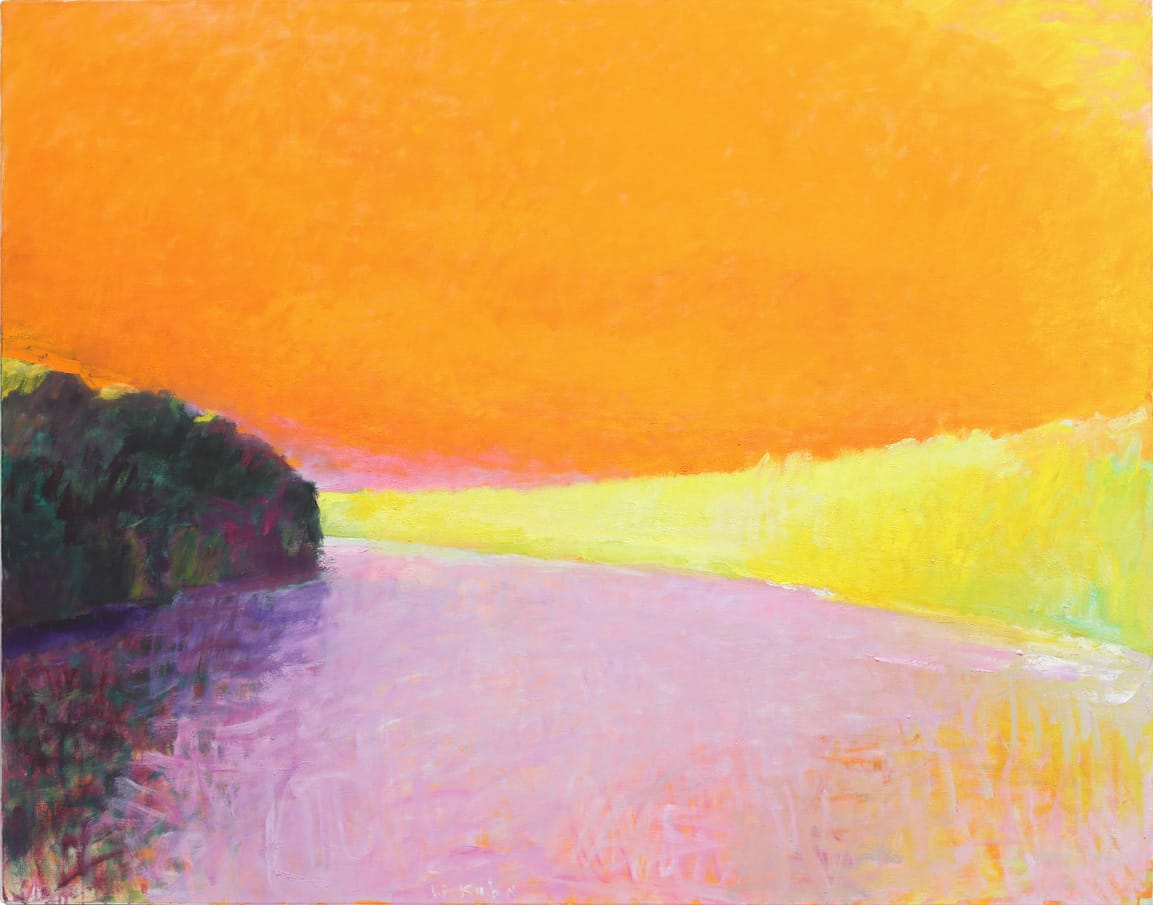
Wolf Kahn is often described as an artist of the Second Generation New York School. His landscapes combine a realistic connection to nature with influences of color field painting. It is precisely this mixture that makes his paintings so recognizable to many viewers: The motifs remain readable, while the areas and color rhythms carry a strong independence.
In art historical classification, Wolf Kahn is considered a significant colorist of his generation. His works show how landscape painting in the second half of the 20th century did not have to be purely representational or completely abstract. Instead, images are created in which light, area, and tonal value guide perception. For the anniversary initiative, this position is important because it not only commemorates the work ceremoniously but also makes it visible in the art historical context.
The archive in Chelsea supports this classification with source material that makes the development of the work comprehensible. This creates an interplay of exhibition, documentation, and research that you can easily classify as a visitor, but also as a reader of an art magazine.
Funding and accompanying programs for the anniversary
The Centenary Initiative also includes funding. The Foundation has announced a total of 400,000 USD in new grants. Additionally, three larger grants are to be awarded in 2027. Museums participating in the program can receive support for framing, conservation, or educational formats. According to the Foundation, an already approved grant helped in the restoration of a work damaged by Hurricane Katrina at the Ogden Museum of Southern Art.
This funding structure shows that the anniversary goes beyond mere exhibition dates. It is also about care, conservation, and public accessibility of works. Especially for an artist like Wolf Kahn, whose significance is closely linked to the dissemination of his images in museums, such measures are an important part of institutional work.
For the readership, this means: Wolf Kahn 100 is not just a series of beautiful exhibitions, but a long-term infrastructure of archiving, research, and program work. This is precisely where the strength of the project lies – it combines memory with materiality and public engagement.