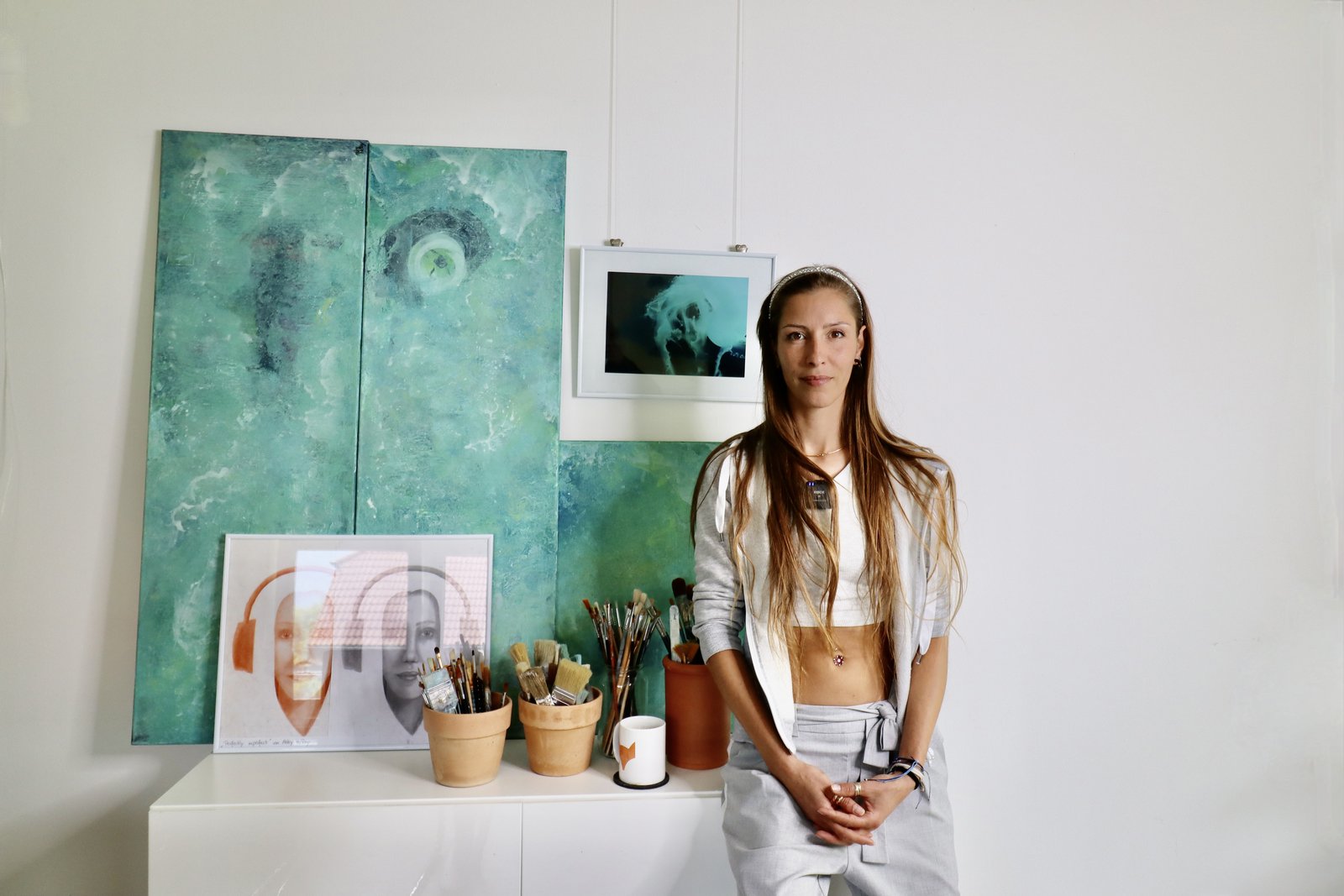
An art study that changes more than technique
Many adults wonder if studying art later in life is still worthwhile. Abby McRey took this step. Her path shows that a part-time art study not only imparts technical knowledge but can also build self-confidence, artistic clarity, and initial professional visibility.
Before studying, Abby worked primarily intuitively. She painted and drew from the gut, without really knowing which materials work together permanently, how important priming, format choice, or paper quality are, and what really matters in an application portfolio. Today, she looks back clearly on this phase: many of her earlier decisions she would not make the same way again.
Before studying: intuitive, but without a professional foundation
Abby describes her work before studying as highly intuitive but not well-founded. She lacked knowledge about material compatibility, formats, primers, and durability. Especially in her application portfolio, she recognizes clear weaknesses in retrospect.
She would no longer submit a portfolio in small formats like DIN A4 today. The combination of unsuitable materials was also a typical beginner's mistake. It was only during her studies that she understood why certain colors and surfaces do not match and what that means for the quality and longevity of a work of art. Those currently facing this task can find tips in the guide Creating an Art Portfolio.
This led to a professional perspective on material, technique, and presentation: High-quality colors, good paper, suitable surfaces, and proper storage are crucial for serious artistic work.
Studying art at 30+: why adults often learn more consciously
Before studying, Abby's artistic successes were modest. She mainly drew and painted for herself or gave pictures to family and friends. There was hardly any professional network, only the studies opened up this area.
This is an important point, especially for adults: An art study for adults not only means artistic work, but also feedback, exchange, and professional orientation. During her studies, Abby understood how important networking is for artists: actively engaging with others about one's own art and gathering feedback.
Why she chose the Achtzig Kunstakademie
For Abby, the decision was clear. She didn't want an anonymous school with large groups, rigid curricula, and a purely theoretical approach. The decisive factor was the impression that art is taught here with experience, joy, and practical relevance.
She particularly values the individual attention. Instead of getting lost in a large class, she experienced the lessons as personal and flexible and was able to delve deeper into topics. When it became apparent that abstract art particularly interested her, this area moved to the forefront. This is crucial for many adults: they don't want to study just anything, but rather work specifically on their own artistic direction.
The own handwriting: from watercolor to abstract art
A central step was the search for her own handwriting. Before studying, Abby did not yet know which direction she wanted to go. She experimented with abstract painting, watercolor, ink, linocut, and photography. Abstract art fascinated her because it is much more complex than it appears at first glance: a demanding field that requires planning, knowledge, and sensitivity.
- Linocut brought her more joy than expected, even though it requires concentration, precision, and patience.
- Ink she experienced as exciting and challenging at the same time in its unpredictability.
- Watercolor matched her personality the most, controlled and yet lively.
This openness helped her to recognize her own preferences and consciously develop her style.
More than painting: children's stories and illustrations
During the course of her studies, another creative area opened up: Abby began writing and illustrating children's stories. This was not originally part of the study program, but it became an important balance to the thesis.
The crucial point was that this idea was not blocked but taken seriously: The stories and illustrations even found their way into the diploma exhibition. For Abby, this was proof that artistic professionalism does not arise from rigid guidelines, but where personal interests are allowed to grow.
The diploma exhibition: from studies to the public
A highlight was the diploma exhibition “Between Dream and Reality” at the Berolina Galerie in the Rathaus Mitte, featuring around forty works. For Abby, it became an emotional turning point: For the first time, she received direct feedback from many people in a single evening, more valuable than any anonymous online comment.
At that moment, she realized that she could see herself as a freelance artist. Particularly impressive: Some works she had doubted herself were particularly well received by the audience. The exhibition showcased her entire journey, from early portfolio works through still lifes, portraits, watercolor, ink, and linocut to abstract works, photographs, and her children's stories.
Abby McRey about her diploma exhibition
In the conversation about the diploma exhibition "Between Dream and Reality," Abby McRey talks about her journey at the Achtzig Kunstakademie Berlin.
Diploma Exhibition "Between Dream and Reality"
Networking, visibility, and first exhibitions
Even during her studies, Abby gained exhibition experience. She emphasizes that during her studies, not only technique and theory were important, but also marketing, presentation, and networking. Art that is not seen remains invisible. Therefore, professional visibility is, for her, part of a serious artistic education.
Art as a Second Career Path
Abby's story shows that art doesn't have to remain a hobby. Originally, she worked in the gastronomy industry in a managerial position. After the Corona period, this secure career path disappeared, and the question arose of a new, viable path. A career change into art became the answer.
Today, she wants to make a name for herself in the art scene, continue exhibiting, and work artistically even in old age. She thinks of exhibitions, children's books, illustrations, and connections to interior design. For her, art is not just a passion but a professional perspective.
Would she recommend studying art?
Your answer is clear: yes. Abby would do the studies again at any time. She describes the study period as motivating, personal, practical, and supportive on a human level. It was especially important to her not to be treated as "one of many," but as a person with her own development, interests, and pace.
"The decision to study art was the best decision of my life."
(Abby McRey)
Conclusion: Studying art at 30+ can be a turning point
Abby McReys' story shows that studying art as an adult can be much more than further education: a new beginning, a second career path, a professional framework for existing creative energy, and the step from intuitive work to a conscious artistic practice.
Anyone over 30 considering studying art might not ask themselves: "Am I too late?" but rather: "What would be possible if I start now?" Even without a high school diploma, the path is open, more on this in the guide Studying without a high school diploma.
Read more: Other students share their experiences of starting late in LIVE interviews: Studying art without prior education: free painting for career changers, self-taught individuals, and those over 30.
Get non-binding advice
What a part-time art study can look like in practice, with or without an art portfolio: Call or write an email.
Achtzig Kunstakademie Berlin
Phone: 0178 44 82 997
Email: diana.achtzig(at)googlemail(dot)com
Course of Study in Fine Arts and Painting
Portfolio Preparation Courses