How does a forgotten image become an icon?
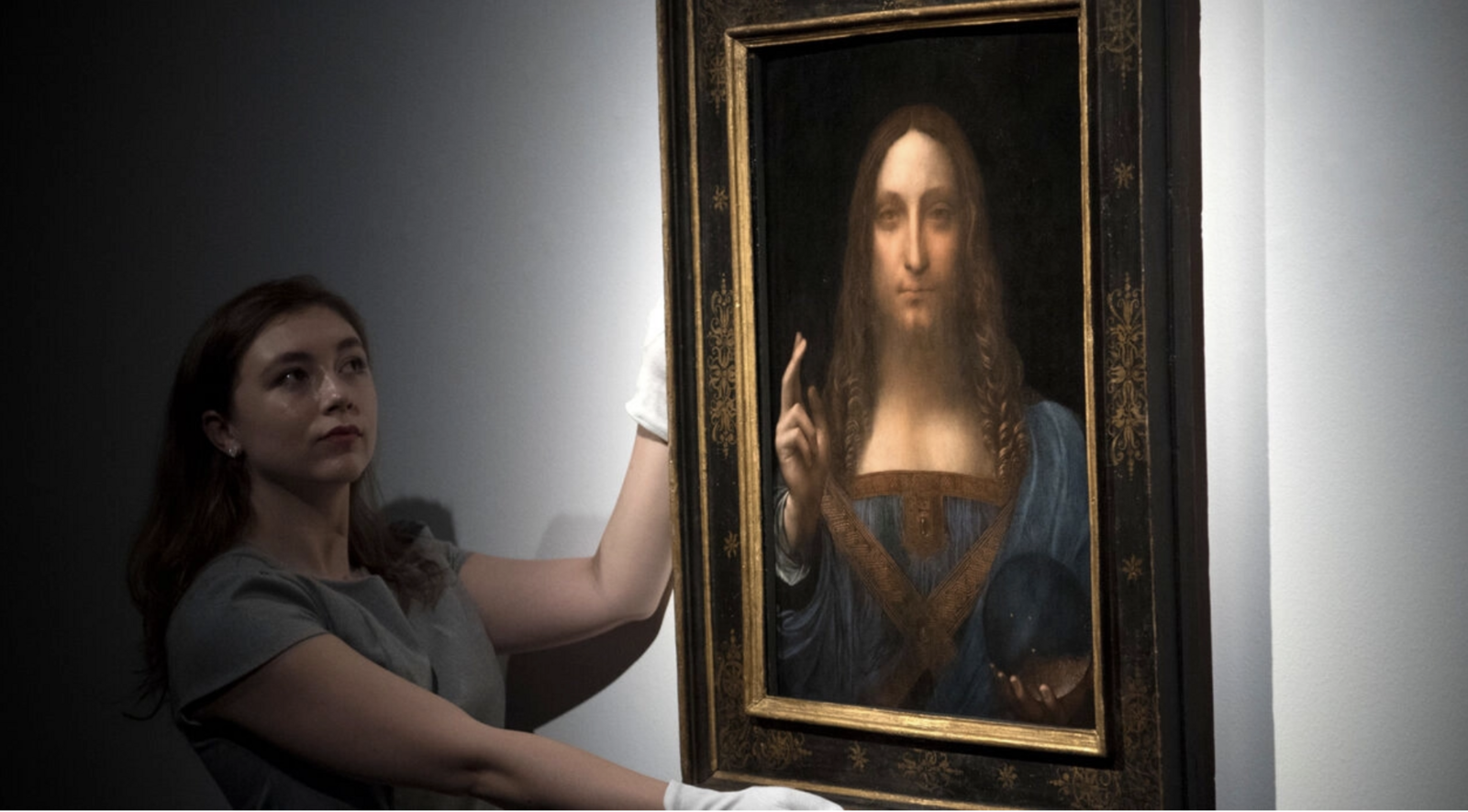
The most expensive painting in the world hung unnoticed for decades in a private house in New Orleans, almost like a forgotten attic find. Its origin, condition, and especially its painter are still disputed today. The painting is called "Salvator Mundi," meaning "Savior of the World." It is painted with oil paint on a panel of walnut wood and measures only about 66 by 46 centimeters.
It depicts Jesus Christ with long, curly hair in a blue robe. With his right hand, he blesses the viewer, while in his left, he holds a transparent orb made of rock crystal. It represents the world and the heavens, which Christ holds in his hand. One detail puzzles experts: A real crystal orb would show the robe behind it distorted and upside down. This is not visible in the painting. Could it be that Leonardo da Vinci, who studied optics intensively, overlooked this effect? For some, this is a hint of another painter, for others, a conscious decision so that the orb does not distract from the face. If you like, you can also think of the orb as a fortune teller's crystal ball – this savior of the world with the blond curls remains enigmatic in any case.
Why are art experts surprised?
The history of the painting probably begins around 1500 in Milan. Leonardo da Vinci was working for the French King Louis XII at the time, who may have commissioned the painting. In the 17th century, the English King Charles I owned a "Salvator Mundi," which is recorded in his estate from 1649. Whether it is exactly this painting is not proven. After that, the trail is lost for about 250 years.
In 1900, the British collector Sir Francis Cook bought the painting for his collection in Richmond near London. At this time, it was heavily overpainted: the face and hair appeared coarse, and the painting was considered a work by Bernardino Luini, a follower of Leonardo. On June 25, 1958, Cook's heirs auctioned 136 paintings at Sotheby’s in London. The "Salvator Mundi" was only offered as a copy after Giovanni Antonio Boltraffio, a student of Leonardo. For just 45 British pounds, it went to a buyer named Kuntz. As it turns out decades later, this was a furniture dealer couple from New Orleans.
In April 2005, the painting reappeared at a small auction house in New Orleans. Art dealers Alexander Parish and Robert Simon from New York recognized that there might be more beneath the overpainting and bought it for 1,175 US dollars. Restorer Dianne Dwyer Modestini uncovered the old paint layer. In doing so, she discovered that the thumb of the blessing hand was initially painted in a different position and then corrected. Such corrections, called pentimenti, are considered an indication of an original: those who copy do not need to improve anything.
In 2008, the painting was shown to a small group of Leonardo experts at the National Gallery in London, including Martin Kemp, Pietro Marani, and Carmen Bambach. Kemp and Marani saw the hand of Leonardo in it. Bambach later stated that she considered the painting mostly a work of Boltraffio and disputed the claim that there was consensus at the time. Experts also argue about the age: the National Gallery dates it to around 1500, Kemp rather to the time after 1507. That a painting, which changed hands for 45 pounds in 1958, is suddenly considered a Leonardo surprises the art world to this day.
For what reasons will it become the most expensive painting in the world?
The breakthrough comes with the exhibition "Leonardo da Vinci: Painter at the Court of Milan" at the National Gallery in London, running from November 2011 to February 2012. There, the "Salvator Mundi" hangs as a work of Leonardo's alongside authenticated paintings by the master. Only about 15 to 20 paintings by Leonardo are preserved worldwide, almost all in museums. A Leonardo in private ownership is a sensation.
In 2013, the auction house Sotheby's brokers the painting without a public auction to the Swiss art dealer Yves Bouvier, who pays around 80 million US dollars. Shortly thereafter, Bouvier sells it for 127.5 million dollars to the Russian billionaire Dmitri Rybolowlew. When Rybolowlew learns of the markup, he sues Bouvier. The years-long legal battle becomes known as the "Bouvier Affair."
On November 15, 2017, Rybolowlew has the painting auctioned at Christie's in New York. The auction house promotes it as "The Last Leonardo" and displays it beforehand in Hong Kong, London, and San Francisco. Unusually, the Renaissance painting does not go under the hammer with the Old Masters but in a contemporary art auction. After about 19 minutes of bidding over the phone, the hammer falls at 400 million dollars, with fees totaling 450.3 million. Never before has more been paid for a work of art.
The buyer is the Saudi prince Badr bin Abdullah, reportedly on behalf of Crown Prince Mohammed bin Salman. The Louvre Abu Dhabi announces it will display the painting in 2018 but cancels the presentation at short notice. It is also missing from the major Leonardo exhibition at the Paris Louvre in 2019. Since then, the public has not seen the world's most expensive painting. Its current whereabouts are officially unknown.
Which paintings are the most expensive in the world?
The "Salvator Mundi" tops the list of the most expensive paintings by a wide margin. The ranking includes public auctions and known private sales. In private sales, prices are often based on press reports and are not officially confirmed. As of early 2026, prices in US dollars without inflation adjustment.
- Leonardo da Vinci: "Salvator Mundi" – 450.3 million (2017, auction at Christie's)
- Willem de Kooning: "Interchange" – around 300 million (2015, private)
- Paul Cézanne: "The Card Players" – over 250 million (2011, private)
- Gustav Klimt: "Portrait of Elisabeth Lederer" – 236.4 million (2025, auction at Sotheby's)
- Paul Gauguin: "Nafea Faa Ipoipo?" – around 210 million (2014, private)
- Jackson Pollock: "Number 17A" – around 200 million (2015, private)
- Andy Warhol: "Shot Sage Blue Marilyn" – 195 million (2022, auction at Christie's)
- Mark Rothko: "No. 6 (Violet, Green and Red)" – around 186 million (2014, private)
- Gustav Klimt: "Water Serpents II" – around 184 million (2013, private)
- Rembrandt: Portraits of Marten Soolmans and Oopjen Coppit – around 180 million (2015, private)
Notable: Two paintings on the list also went through Yves Bouvier to Dmitri Rybolowlew – Rothko's "No. 6" and Klimt's "Water Serpents II". They are also part of the "Bouvier Affair". The Rembrandt pair was jointly purchased by the Louvre and the Rijksmuseum; since then, the two portraits alternate between Paris and Amsterdam.