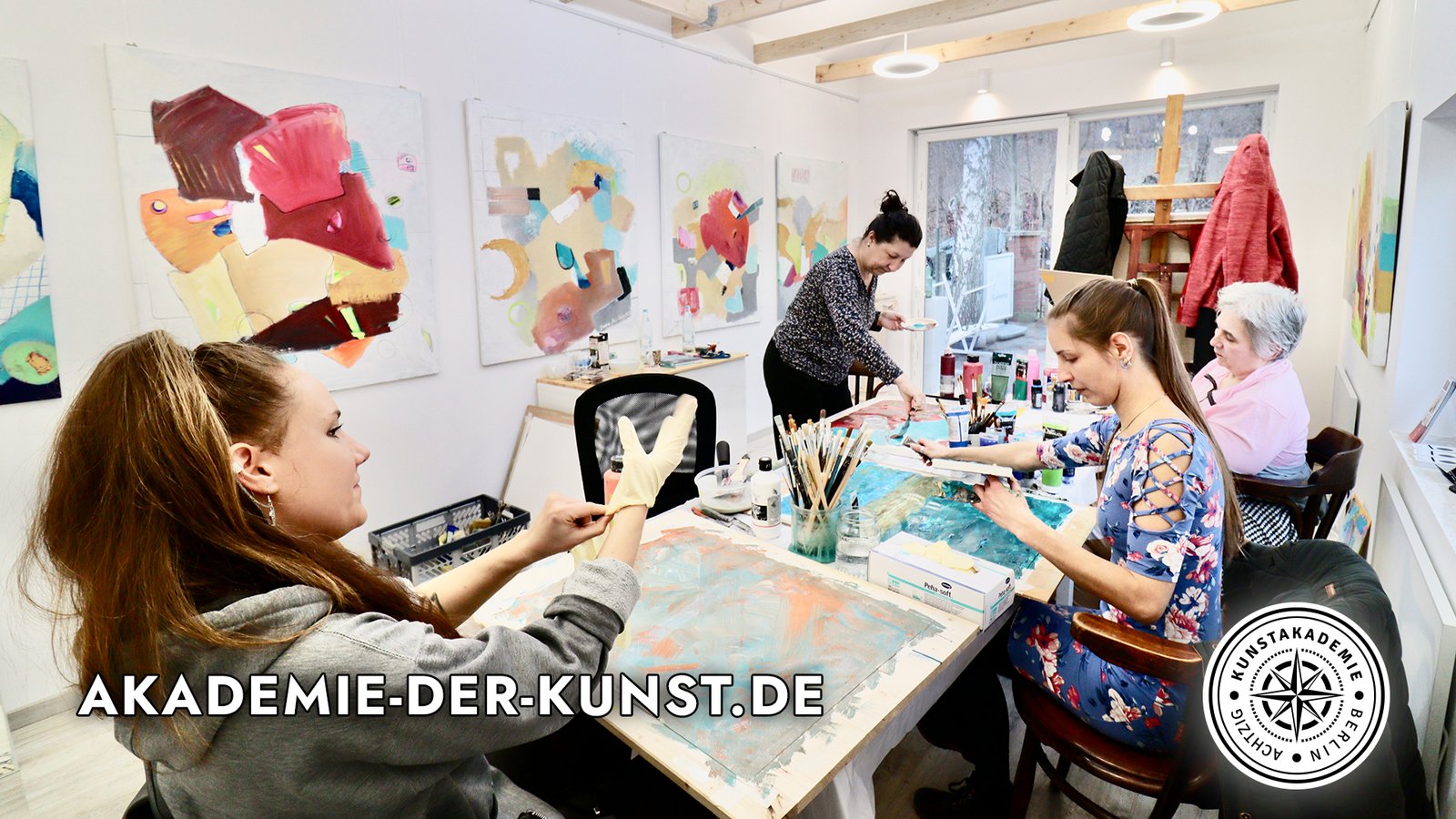
Study art alongside work, family, and retirement
Many people have been painting for years – after work, on weekends, or since retirement. At some point, the question arises: Is it enough to exhibit and sell one's own paintings? A part-time distance learning course or a senior study in Fine Arts and Painting can be the step from a hobby to professional artistic work.
This article shows what such a study offers, how it differs from on-campus studies, how it is perceived, and what you should pay attention to when choosing.
The Most Important Points in Brief
- A distance or senior study can be combined with work, family, and retirement – you largely determine the place and pace yourself.
- A study does not sell paintings by itself. However, it helps with craftsmanship, personal style, professional presentation, and knowledge about the art market.
- Galleries and collectors primarily focus on your works, your exhibitions, and your CV – a solid education strengthens this CV.
- Degrees from private academies are usually not state-recognized university degrees. Ask precisely before enrolling.
- When choosing, pay attention to support, feedback, exhibition opportunities, costs, and contract conditions.
What is a distance learning or senior study in Fine Arts?
In a distance learning program, you primarily work from home or in your own studio. You receive assignments and learning materials, submit your work, and receive feedback – in writing, in online meetings, or during in-person sessions. A part-time distance learning program is designed to be manageable alongside a job.
A senior study program is aimed at people in the second half of life. At universities, this is usually an auditing program, such as in art history, without a practical component and without a degree. Private art academies, on the other hand, offer practical courses in painting and fine arts aimed at older students.
In terms of content, good programs cover similar areas as an on-campus study:
- Artistic practice: Drawing, painting, color and composition, often also mixed techniques and experiments with materials.
- Art history and theory: Eras, movements, and contemporary positions to be able to contextualize one's own work.
- Own position: the development of a recognizable style and series of works.
- Professional practice: Portfolio, presentation, exhibition, pricing, and art marketing.
How studying art helps you sell your art
A degree alone does not convince any collector. However, a study program imparts many things that are crucial for sales success:
- Solid craftsmanship: You learn techniques and material science – from proper priming to the durability of colors. Buyers expect works that last for decades.
- A unique signature: Galleries seek recognizable positions and cohesive series of works, not a collection of individual attempts.
- Handling criticism: Regular feedback from instructors and fellow students sharpens your perspective. Those who have learned to handle criticism develop more quickly.
- Talking about your own art: Art history and theory help you contextualize your work and convincingly explain it in conversations with collectors, curators, or the press.
- Professional presentation: A portfolio, artist statement, CV, and photos of your work are the foundation of any application to galleries and exhibitions.
- Knowledge of the art market: Understanding how galleries operate, how to find realistic prices, and how to present yourself online are part of a good study program.
- Network and exhibition: Contacts with fellow students, instructors, and exhibition venues, as well as a final exhibition, are often the first appearance before an audience.
Our guide How Your Artworks Get into a Gallery describes what the path to a gallery looks like in detail.
Distance learning or on-campus study: the most important differences
Both paths can lead to a professional artistic practice. Which one fits better depends on your life situation and your goals.
Advantages of distance learning
- Flexibility: You learn when and where it suits you, and you can continue your job, family, or retirement.
- Your own pace: You take as much time as you need for a topic.
- No relocation: You don't have to move to a university town and save on travel and living costs.
- Your own studio: You work from the start in your own environment – just like later as a freelance artist.
Advantages of on-campus study
- Workshops and studios: You have access to spaces, workshops, and materials, for example for printmaking or sculpture.
- Daily exchange: Conversations with fellow students and teachers happen incidentally, not just at fixed times.
- Local scene: Galleries, museums, and exhibitions in the university town are directly accessible.
Distance learning requires more self-discipline. Those who can organize themselves well and work regularly benefit from the freedom to adapt their studies to their own life.
How is a distance learning program in art regarded?
In the art world, what you show is what matters most. Galleries, curators, and collectors primarily evaluate your works, your exhibitions, and your development. A solid education is part of your resume and shows that you are seriously engaged with art – whether through distance learning or on-campus study is secondary.
However, there are formal differences you should be aware of:
- State art colleges award state-recognized degrees such as diploma, bachelor's, or master's. Fine arts are almost exclusively offered as on-campus studies there.
- Private art academies usually award their own degrees, such as a diploma or a master student title from the academy. These are usually not state-recognized university degrees.
For a career as a freelance artist, a state degree is not a prerequisite. It becomes important if you want to teach at a school or apply for positions that require a university degree. Therefore, ask precisely before enrolling what degree you will receive.
Can you study art without a high school diploma?
Often yes. Many state art colleges admit applicants with special artistic talent even without a high school diploma. You demonstrate your talent with a portfolio and an entrance exam; the exact rules depend on the federal state and the college.
Private art academies set their own admission requirements. Often a portfolio with your own work and a personal interview are sufficient. For auditing or senior studies at universities, you usually don't need a high school diploma either. Tips for a convincing portfolio can be found in our article Application Portfolio for Art Studies.
What do you earn with an art degree?
There is no blanket answer to this. In the visual arts, incomes vary greatly: a few artists earn very well, many do not live solely from the sale of their works. The incomes that freelance visual artists report to the Künstlersozialkasse are on average significantly below the general average income.
Therefore, a degree is not a guarantee of a high income. However, it improves your chances because you present yourself more professionally, know realistic prices, and have contacts. Many artists combine several sources of income:
- Sale of originals through galleries, exhibitions, art fairs, and their own website
- Commissions, editions, and prints
- Courses, workshops, and art education
- Teaching, art education, or art therapy (with appropriate additional qualification)
Especially for working professionals and retirees, distance learning is a good way to build artistic work without financial pressure and to develop sales step by step.
What you should consider when choosing a distance learning program
The offers vary greatly in quality, support, and price. These questions will help you compare:
- Degree: What degree will you receive, and is it officially recognized?
- Approval: Paid distance learning courses in Germany usually require approval from the State Central Office for Distance Learning (ZFU). Ask about it.
- Support: How often do you receive feedback, from whom, and in what form – written, online, or in person?
- Instructors: Do the lecturers exhibit themselves, and do they know the art market from their own practice?
- On-site phases: Are there on-site appointments, such as for studio visits, workshops, or exhibition visits?
- Exhibition: Is a final exhibition planned, and where will it take place?
- Costs and contract: What is the total cost of the study, what is included, and what are the duration and cancellation periods?
- Getting to know: Can you have a preliminary consultation or attend a trial lesson?
Conclusion: A degree opens doors – you have to sell yourself
A distance learning course or senior studies in Fine Arts and Painting does not sell your paintings by itself. However, it provides you with what constitutes professional artistic work: secure craftsmanship, a personal signature, the ability to talk about your art, and the knowledge of how galleries and the art market work. Those who choose a reputable program, work regularly, and exhibit early create good conditions for successfully showcasing and selling their own art.
Note: Distance learning at the Achtzig Kunstakademie Berlin
The Achtzig Kunstakademie Berlin offers a part-time distance learning program in Fine Arts and Painting, which is also suitable as a senior study, as well as a course in Art Marketing and Portfolio Preparation Courses. According to the academy, the program concludes with a diploma exhibition.
More about the distance learning program is shared by the gallerist and lecturer Diana Achtzig in the podcast "Kunst verkaufen", for example in the episodes "Fernstudium Kunstakademie für Malerei Berlin" (103) and "Art Coach Berlin" (182).
You can schedule a consultation appointment by phone: 0178 4482997.