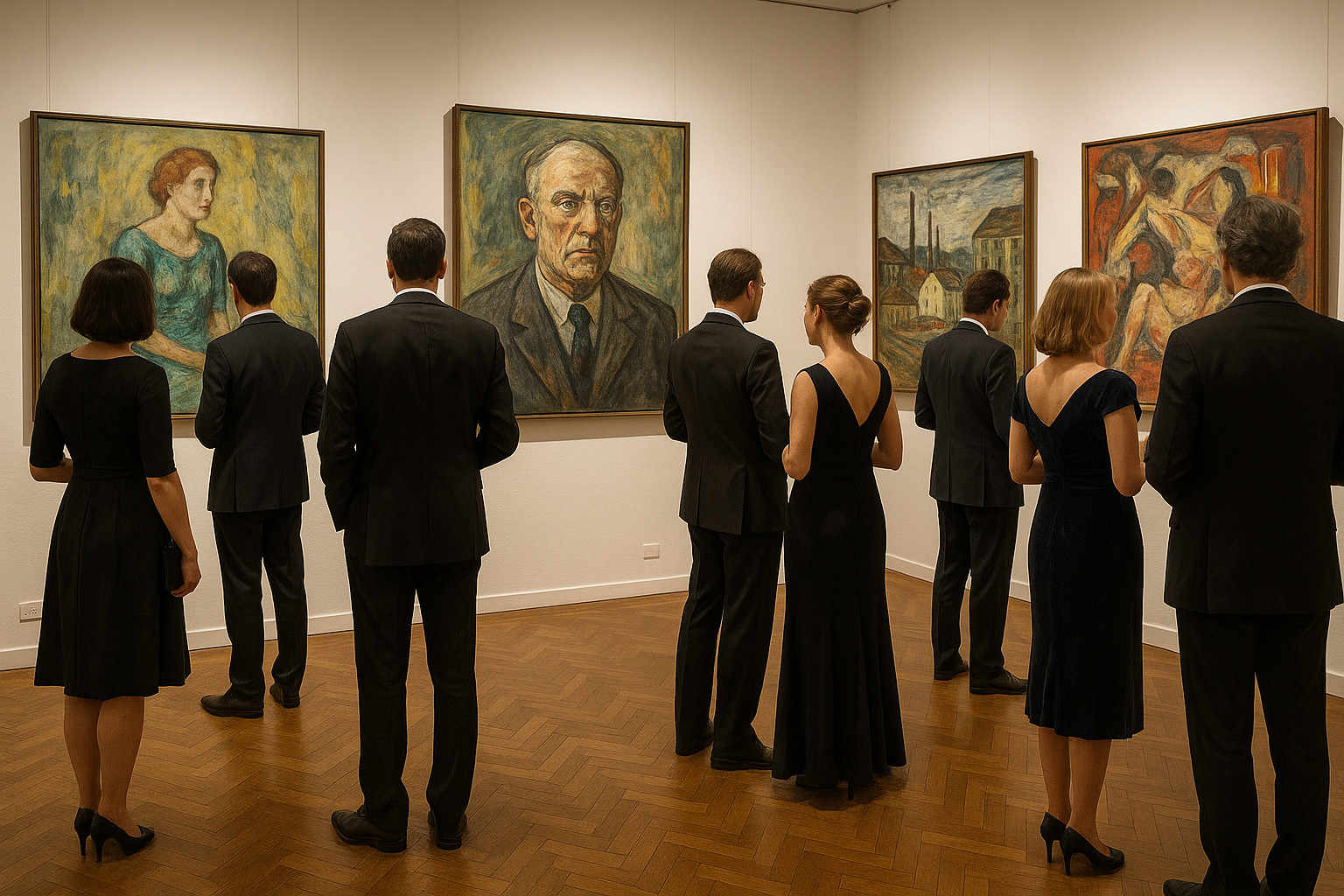
A painter of the Leipzig School
Walter Libuda was born on June 24, 1950, in Zechau-Leesen in the Altenburger Land and died on July 6, 2021, at the age of 71 in Berlin. He belongs to the generation of painters who studied at the Hochschule für Grafik und Buchkunst Leipzig in the 1970s and are associated with the Leipzig School around Bernhard Heisig.
He should not be confused with the New Leipzig School, under whose name younger painters like Neo Rauch have become internationally known since the 2000s. Libuda went his own way early on: His paintings are full of enigmatic figures and cannot be clearly assigned to any direction.
From theater painter to master student
Libuda came to art through craftsmanship. After an apprenticeship as a painter from 1965 to 1968, he worked as a theater painter at the Landestheater Altenburg until 1971. From 1973 to 1978, he studied at the Leipzig Academy of Visual Arts, among others with Arno Rink, and was subsequently a master student with Bernhard Heisig until 1979. Until 1985, he taught as an assistant at the academy.
In 1985, he moved to Berlin, and in 2004 to Schildow on the northern outskirts, where he lived and worked until the end.
Figures Between Grotesque and Dream
In Libuda's paintings, deformed, often isolated figures inhabit stage-like spaces; figurative and abstract elements stand close together. The critic Peter Funken called his painting in 2009 in Kunstforum "an existentialist art" rooted in Romanticism. Libuda worked layer by layer and often over years on a painting.
A key work is "Die Schleuse" from 1988/89 in the Neue Nationalgalerie Berlin: a throng of border guards and refugees in a tunnel, painted shortly before the fall of the Wall. Typical are groups of works with titles like "Fischschlucker," "Horcher," "Landvermesser," or "Die Große Schwester." Since the 1980s, Libuda also created picture boxes, colorful ceramics, and bronzes.
Exhibitions, Awards and Collections
Even during the GDR era, Libuda was represented at the major art exhibitions in Dresden, and in 1990 he showcased works at the Venice Biennale. In 1992, the Neue Nationalgalerie Berlin dedicated the exhibition "Karawane" to him, and in 2000, the Lindenau-Museum Altenburg held the retrospective "Die Höhle füllt den Berg". Further solo exhibitions followed, including at the Kunsthalle Rostock (2003) and in 2020 at the Kunstmuseum Ahrenshoop.
In 1999, he received the Fred-Thieler-Preis for painting from the Berlinische Galerie, and in 2000 the Gerhard-Altenbourg-Preis. Since 1998, he was a member of the Saxon Academy of Arts. His works are owned by, among others, the Neue Nationalgalerie and the Berlinische Galerie, the Galerie Neue Meister in Dresden, the Museum der bildenden Künste Leipzig, the Sprengel Museum Hannover, and the British Museum in London.
Collect Libuda
Paintings, graphics, and sculptures by Walter Libuda are traded through galleries and auction houses. Those who wish to buy should ensure a complete provenance, be able to assign the work to a work group, and, if necessary, contact galleries that have exhibited the artist for years. Why prices and records alone say little about the value of a painting is explained in our article Art as an Investment.
Sources and Literature
- Walter Libuda on Wikipedia
- Saxon Academy of Arts: Walter Libuda
- walterlibuda.de: Vita
- Eugen Blume: Walter Libuda. Cold in the Forest. Berlin 1997
- Katrin Arrieta: Walter Libuda. Land Surveyor. Kunsthalle Rostock 2003
- Peter Funken: Walter Libuda. The Big Sister. In: Kunstforum International, Vol. 195, 2009