Record prices are the exception
The major auction houses repeatedly report new records, and the global art market generates billions every year. Is the art market only for wealthy collectors and financially strong investors, or can art also be an investment for private buyers?
A well-known example from Germany: Max Beckmann's (1884–1950) painting "Female Head in Blue and Gray" (1942, oil on canvas, 60 × 30 cm), better known as "The Egyptian Woman," was sold for 4.7 million euros at the Berlin auction house Villa Grisebach on May 31, 2018. [3] It was estimated at up to 2 million euros. At that time, it was the highest price ever achieved for an artwork at a German auction. However, such results are exceptions and not a benchmark for the art market as a whole.
The Essentials in Brief
- Record prices like Beckmann's "Egyptian Woman" are isolated cases.
- The price of a work depends heavily on technique, condition, provenance, and exhibition history.
- Art does not generate ongoing income and is often slow to sell.
- Those who buy art should primarily enjoy the work, not rely on a return.
Why the "Ägypterin" became so expensive
Since its creation in 1942, the painting had never been sold. [4] Beckmann painted it in Amsterdam, where he had gone into exile from the Nazis. Art historically, the mysterious light from below is particularly noteworthy, reminiscent of old masters like Rembrandt (1606–1669). Who is portrayed is uncertain: it is suspected to be Beckmann's second wife Mathilde, known as "Quappi," or the Egyptian photo model Nimet Eloui Bey.
Several factors drove the price. The work is mentioned in Beckmann's diary, thus its authenticity is considered secure. Additionally, it has a long exhibition history: the "Egyptian Woman" was featured in major Beckmann exhibitions in Boston, New York, and Chicago, later in Hamburg, Frankfurt am Main, London, Paris, Munich, and Brussels, and in the 1980s in Berlin, Saint Louis, and Los Angeles. [5] Works with secured provenance, good documentation, and a museum past are rare and accordingly in demand.
Technique and condition determine the price
How different prices for works by the same artist can be is shown by auction results of the Bauhaus artist Oskar Schlemmer (1888–1943) at Ketterer Kunst, each including premium:
- The lithograph "Figurenplan" (1919) achieved 3,600 euros in 2007, with an estimate of 4,000 euros. [6]
- The oil painting "Figur auf grauem Grund" (1928, 58.3 × 23.7 cm) brought 500,200 euros in 2013, estimated at 240,000 euros. [7]
- The pencil drawing "Treppenszene" (1931, 28.3 × 22 cm) achieved 100,000 euros in 2017, with an estimate of 25,000 euros. [8]
The examples do not show an increase in value of a single work, but rather how strongly technique and rarity determine the price: A lithograph exists in many prints, an oil painting is unique. Works of classical modernism are in demand and their number is limited. Yet even here, results can fall below the estimate, as the lithograph shows.
What you should pay attention to when buying art
Anyone who wants to buy art should be familiar with the market or seek good advice, for example, from a gallery or auction house with a good reputation. Before purchasing, it is worth checking these points:
- Authenticity: Is the work listed in the catalog raisonné or verified by a recognized appraisal? Authenticity is the most important point when buying art, says the Berlin gallerist Diana Achtzig.
- Provenance: Can the origin be traced seamlessly? This also protects against looted art.
- Condition: Restorations and damages reduce the value.
- Costs: At auctions, a premium is added to the hammer price, and taxes, transport, framing, and insurance may also apply.
- Price comparison: Auction results of comparable works provide guidance.
The risks of art as an investment
Unlike stocks or bonds, art does not yield dividends or interest. A profit is only made upon sale, and that can take time: A buyer must be found for a work at the right time, and galleries and auction houses retain a portion of the proceeds. Insurance, proper storage, and occasional restoration also cost additional money.
Especially with contemporary art and young artists, prices are difficult to predict. Only a few positions establish themselves in the market in the long term. You should therefore approach promises of secure returns with caution. This article is not investment advice.
Young Art: buy what touches you
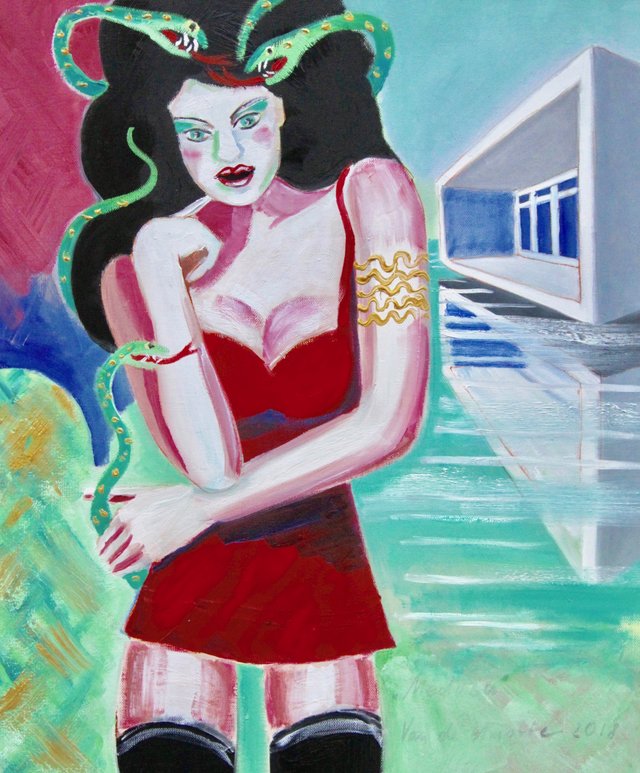
Young art is significantly cheaper than works of classical modernism and offers the opportunity to accompany artists over the years. An example is the painter Anton Van De Amoste, who is part of the Berlin School and is represented by the Achtzig Galerie.
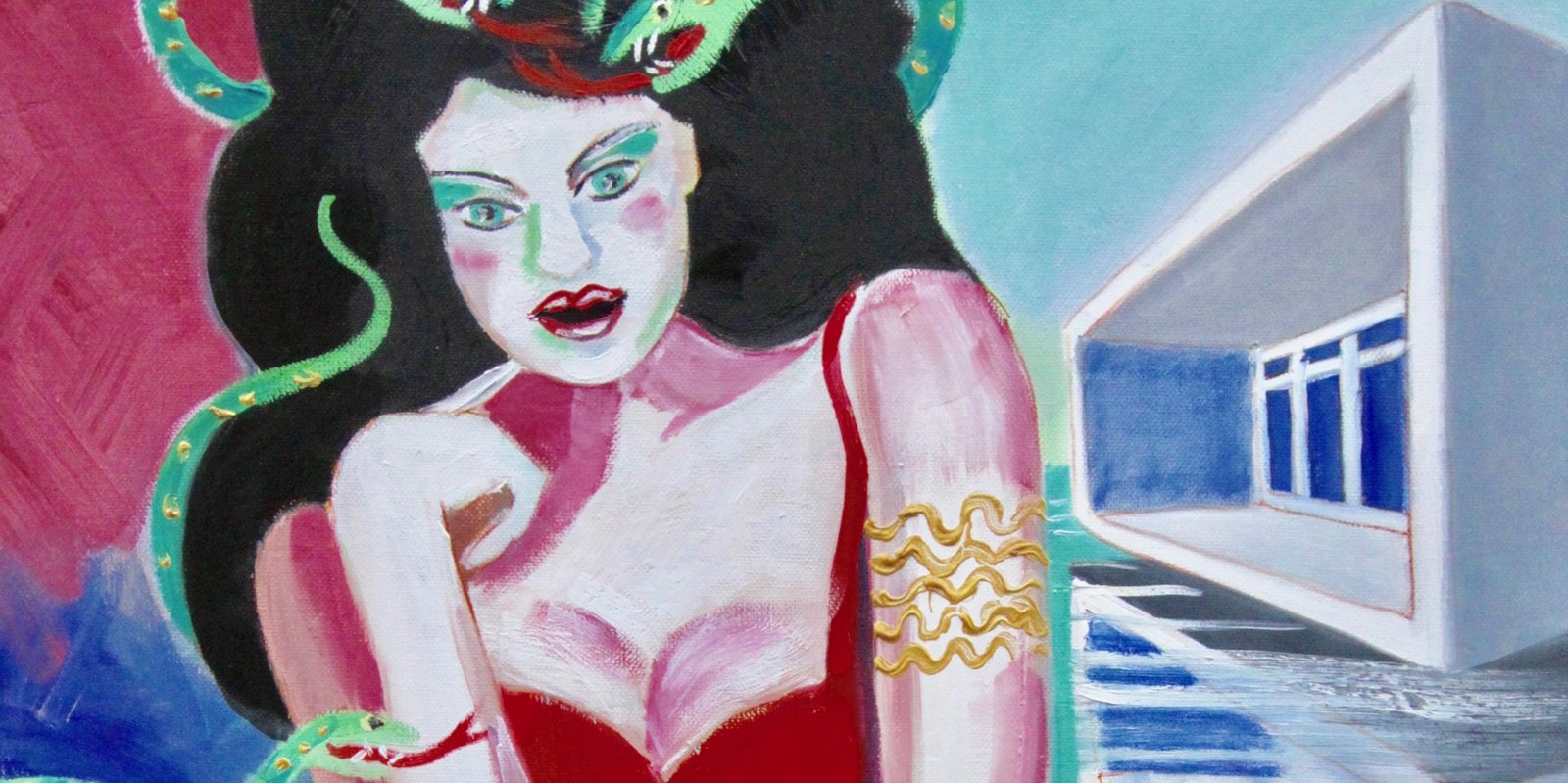
Van De Amoste paints young women as Aphrodite, Danaë, as Cundrie la Surziere from Wolfram von Eschenbach's "Parzival" or as Medusa, embedded in modern or historical architecture, in bright oil colors on canvas. It is intriguing that he chooses figures that are considered ugly or monstrous in myth and literature. Cundrie is described as extremely ugly but clever and learned. Van De Amoste gives her a beautiful face and portrays her as a seductress.
Similarly with Medusa: In Greek mythology, she is one of the three Gorgons, alongside her sisters Stheno and Euryale. According to Ovid, she was originally a beautiful young woman until the goddess Athena transformed her into a monster with snake hair, whose gaze turned anyone to stone. Van De Amoste's Medusa is dangerous and at the same time an erotic femme fatale. Her golden bracelet references the female images from Gustav Klimt's Golden Period.





Conclusion: Joy in the work instead of promises of returns
Art can significantly increase in value in individual cases, as the examples of Beckmann and Schlemmer show. Therefore, it is not a reliable investment: records are rare, prices fluctuate, and costs and sales duration reduce potential profits. Those who buy art should primarily choose a piece they like and enjoy living with.
Besides the financial aspect, art has other advantages: it beautifies homes, offices, and practices and can shape a company's image with customers and employees. More tips for beginners can be found in the article about the watercolors of René Du Belle.